Open Energy Dashboard

Overview
The Open Energy Dashboard (OED) is a crucial open-source project that facilitates the visualization of energy information through a web-based application. Its significance lies in promoting collaboration and knowledge-sharing to advance common sustainability goals. Unlike other proprietary dashboards, OED is free, portable, and driven by user needs, embodying principles such as perpetual freedom, shared advancements, and user-centric design. The typical user, ranging from energy managers to sustainability professionals, benefits from its user-friendly interface and diverse functionalities, allowing easy management of energy data without the need for external support.
Information
-
Source Code: https://github.com/oss-slu/OED

-
Client: Steve Huss-Lederman
-
Current Tech Lead: All Tech leads under OSS collaborate on this project
-
Developers:
- Lakshmi Mamillapalli

- Colin Seper (capstone)
- Thomas Marcus (capstone)
- Joijanae Laws (capstone)
- Nischita Nannapaneni (Alumini)
- Mark Mehta (Alumini)
- Lakshmi Mamillapalli
-
Start Date: September 2023
-
Adoption Date: September 2023
-
Technologies Used:
- PostgreSQL
- React
- Redux
- Node.js
- Javascript
- Plotly.js
- Typescript
- Javascript Promises
- Chai
- Mocha
-
Type: Desktop
-
License: MPL version 3.0
User Guide
-
Developers: The developer website is available to learn about working with the OED project.
-
Production/Sites: The admin installation page is available to learn about installing OED for a production environment (normal OED site). These are part of the overall admin help pages for OED.
Technical Information
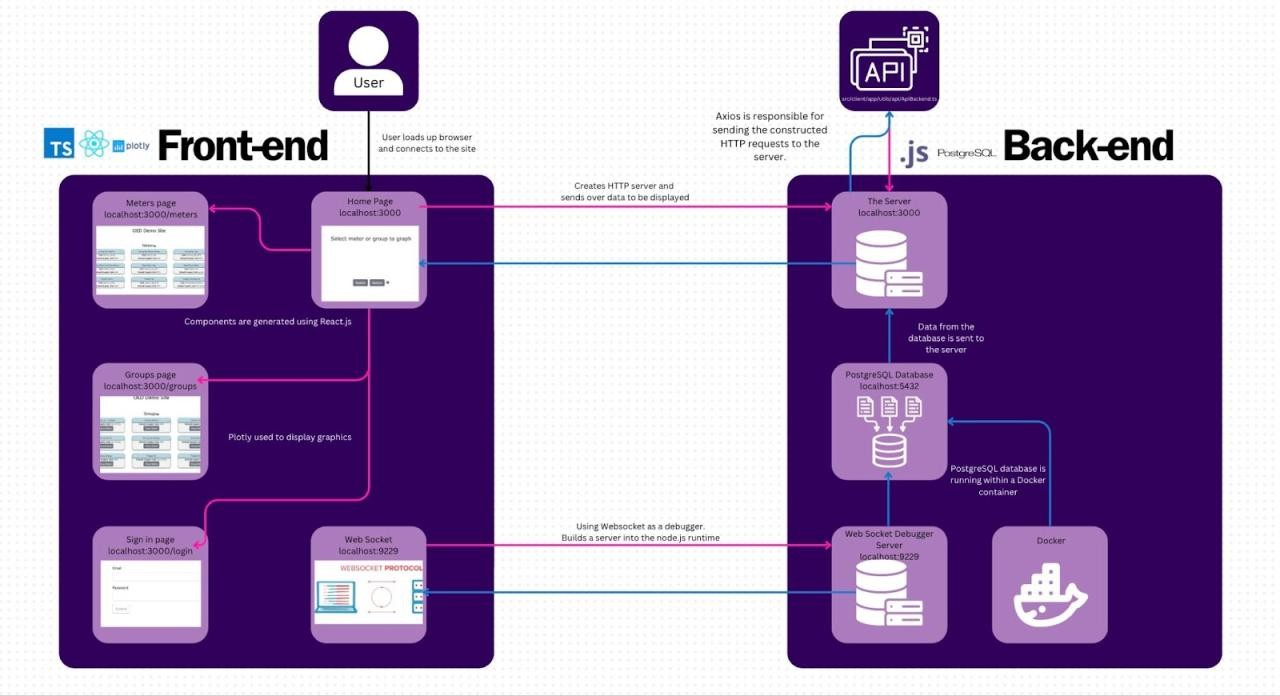
Technical Overview
Overview of the software architecture.
Development Priorities
- Ensuring that the dashboard remains easy to use, especially for non-technical users
- Fixing issues related to incorrect or inconsistent data display
- Improving the speed and responsiveness of the dashboard, particularly when handling large datasets
- Addressing and resolving any bugs or glitches reported by users or contributors
Get Involved
If you would like to contribute to this project, please visit our GitHub page to create your own issues or pull requests.